

The Philippines is one of Southeast Asia's fastest-growing digital payment markets, with 66.64 million digital payment users and over $49.6 billion in digital transaction volume projected for 2025 (Worldpay). GCash has near-ubiquitous reach across 94 million users and 6 million merchants. With roughly 50% of the population still unbanked, cash and COD (Cash on Delivery) remain structurally embedded alongside digital channels — a combination that defines the Philippine checkout experience.
Philippine market snapshot
Country | Philippines |
|---|---|
Population | 116.8 million |
GDP (USD) | $491.0 billion |
Currency | Philippine Peso (PHP) |
Digital payment transaction volume (2025) | $49.6 billion (Worldpay) |
Digital payment users (2025) | 66.64 million (Worldpay) |
Which payment methods do Philippine buyers use most?
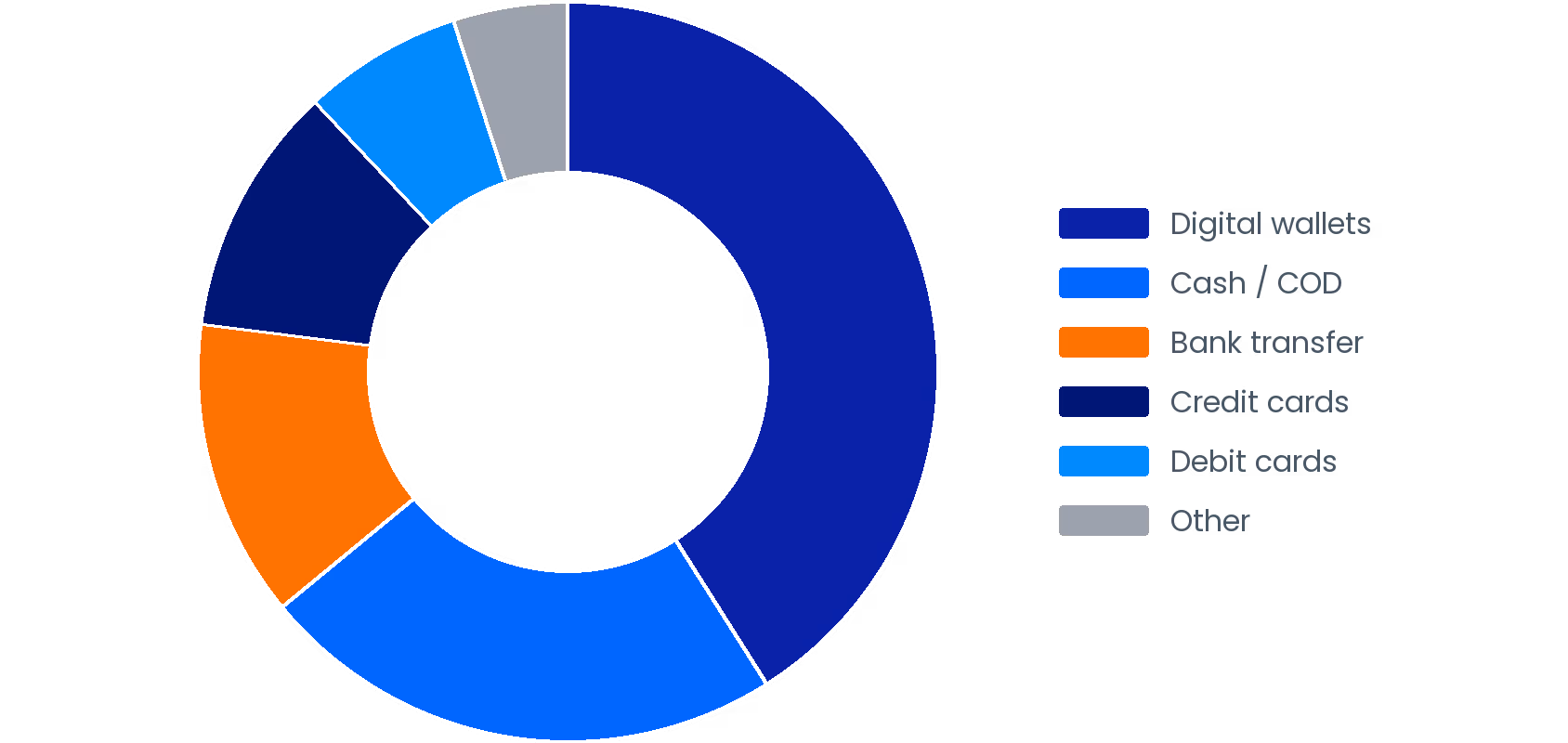
Digital wallets dominate at 41% of e-Commerce transactions in 2025, driven by GCash's outsized reach. COD holds 23%, reflecting the large unbanked population. Bank transfer is third at 13% and is projected to be the fastest-growing category by 2030. Philippines' 2025 payment breakdown:
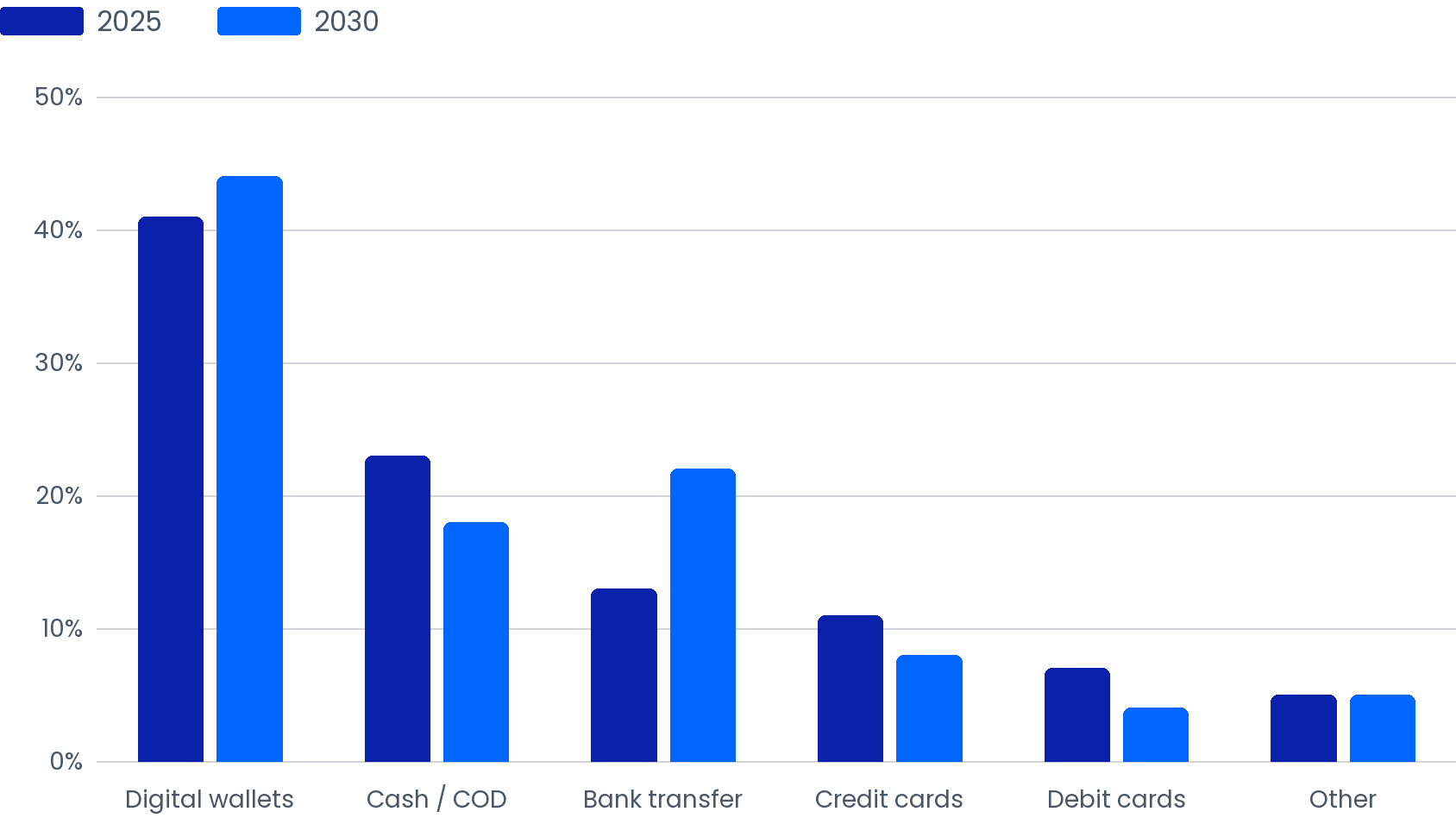
- Digital wallets — 41%, rising to 44% by 2030. GCash anchors the market with 94 million users and 6 million merchant acceptance points. Maya, Lazada Wallet, and ShopeePay hold secondary positions.
- Cash / COD — 23%, declining to 18% by 2030. Approximately 50% of the Philippine population holds no bank account, making COD the primary access point for online shopping among underbanked consumers.
- Bank transfer — 13%, projected to reach 22% by 2030. Growth is powered by InstaPay and QR Ph (Quick Response Philippine), enabling fast A2A (Account-to-Account) transfers. Bank transfer is on track to be the fastest-growing category through 2030.
- Credit cards — 11%, declining to 8% by 2030. Below-regional-average penetration, contracting as consumers shift toward wallet and transfer-based methods. Primary schemes are Visa and Mastercard.
- Debit cards — 7%, declining to 4% by 2030. Primary card schemes are Visa and Mastercard alongside local networks.
Philippines e-Commerce payment method share (2025)
How GCash, bank transfers, and cards work for merchants in the Philippines
The Philippines combines a dominant wallet (GCash), significant COD volume, and growing bank transfer use — each method carrying different integration requirements, settlement timelines, and buyer eligibility constraints. The table below maps these variables for each method.
Digital wallets account for 41% of Philippine online transaction volume, with GCash, Maya, Lazada Wallet, and ShopeePay among the available platforms. Together, digital wallets and COD account for 64%.
Payment method | Key platforms | Approx. share | What merchants should know |
|---|---|---|---|
Digital Wallets | GCash, Maya, Lazada Wallet, ShopeePay | ~41% | GCash is a leading platform within the wider wallet market. |
Cash / COD | Logistics partners, marketplace fulfillment | ~23% | Merchants need to account for delivery refusal and slower cash collection. |
Bank Transfer | InstaPay, QR Ph | ~13% | InstaPay supports real-time, low-value electronic fund transfers; payment confirmation should not be confused with merchant settlement. |
Credit Cards | Visa, Mastercard | ~11% | Cross-border authorization rates run below the regional average; routing via a local acquirer is recommended. |
Debit Cards | Visa, Mastercard, local schemes | ~7% | Supports buyers who prefer to pay directly from their bank balance. |
How payment methods in the Philippines will change by 2030
Digital wallets grow from 41% to 44% by 2030. Bank transfer is the standout growth story — projected to nearly double from 13% to 22%, driven by InstaPay and QR Ph adoption. COD declines from 23% to 18% as digital payment infrastructure extends to rural areas. For a structured approach to deciding which methods to activate first, the payment method quadrant framework provides a decision model applicable across the Philippine market.
Philippines payment method share: 2025 vs 2030 (%)